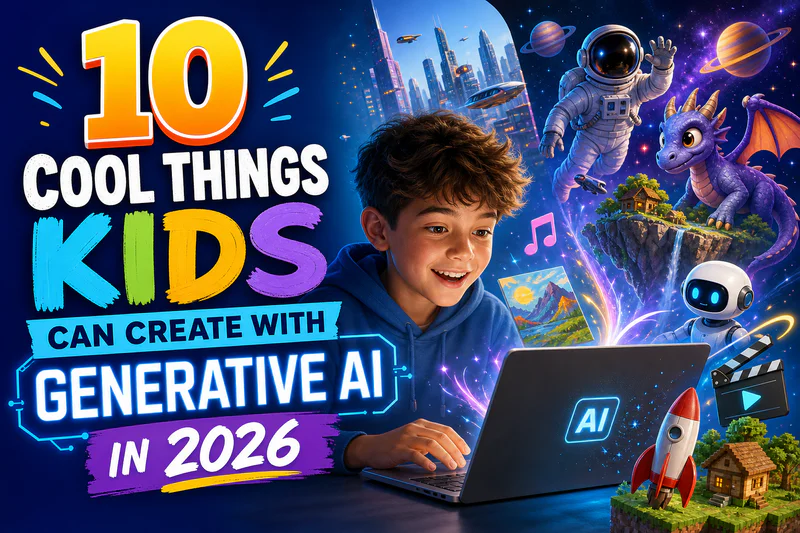
Generative AI for kids is no longer a future concept, it is a present-day creative superpower. In 2026, approximately 44% of children are actively engaging with generative AI tools, according to recent education survey data, and the smartest parents are channeling that curiosity toward creation, not just consumption.
This guide walks through 10 genuinely impressive projects kids can build using generative AI today, and how those projects connect to deeper skills in coding, mathematics, and app development.
What Is Generative AI? (And Why Kids Need to Learn It)
Generative AI is software that can produce new content, images, text, music, code, or video, based on a user's instructions (called "prompts"). Tools like ChatGPT, DALL·E, and Boomy are powered by large language models and neural networks trained on massive datasets.
For kids, what matters most is this: generative AI removes the technical barrier between an idea and its creation. A child who wants to illustrate their own story no longer needs to be a skilled artist. A kid who wants to compose a background track for their game doesn't need a music degree. The creative floor has dropped dramatically, which means the ceiling for what children can build has never been higher.
Understanding generative AI for kids also lays the conceptual groundwork for deeper STEM learning. Once a child understands why AI generates what it does, through patterns, probabilities, and data, they naturally become curious about the programming behind it. That curiosity is the bridge to online coding classes for kids, Python for kids, Scratch programming for kids, and beyond.
To explore the broader landscape of what's possible, the uses of generative AI for kids go far beyond homework help, they span art, music, storytelling, engineering, and entrepreneurship.
10 Cool Things Kids Can Create with Generative AI

The table below is a practical reference for parents and educators. Each project is achievable in 2026 with free or low-cost kid-friendly tools, and each builds measurable STEM and creative skills.
Each of these ten projects represents a genuine learning pathway, not just a fun afternoon activity. Let's look more closely at the ones with the highest STEM payoff.
AI Art & Image Creation
Using tools like DALL·E or Canva AI, kids write descriptive prompts that generate original images. This teaches visual literacy and pattern recognition, and it's a powerful introduction to how generative AI for kids interprets language as structured data. Children quickly learn that more precise instructions yield better results, which is an early lesson in computational thinking.
Game Design with Scratch Programming for Kids

Scratch programming for kids is one of the most effective entry points into AI-assisted game creation. Children can use AI tools to generate character sprites, background music, or storyline dialogue, then import those assets into their Scratch projects. This bridges creative AI generation with genuine block-based programming logic. Scratch programming for kids also integrates naturally with generative AI for kids because both platforms reward experimentation and iteration, key engineering mindsets.
AI-Powered Coding Projects with Python
When kids are ready to go beyond drag-and-drop, Python for kids is the next logical step. Python is the dominant language in AI and machine learning, meaning children can use Python to call AI APIs, build simple image classifiers, or create text generators of their own. Enrolling in a structured generative AI for kids course that combines Python with real AI concepts gives children a significant academic and career advantage. Python for kids makes the "magic" of AI explainable, and reproducible.
Chatbot Building and App Development
Building a chatbot is one of the most motivating generative AI for kids projects because the output is immediately interactive. Using platforms like Teachable Machine or beginner-friendly low-code tools, kids can train simple AI models and embed them in web or mobile interfaces. This is a natural gateway into app development for kids, where children design user interfaces, manage data flows, and think like product builders. App development classes for kids that incorporate AI components are increasingly in demand in 2026.
AI-Driven Math Puzzles
Generative AI for kids can create personalized math challenges, logic puzzles, and pattern-based problems on demand. When a child prompts an AI to generate increasingly complex number sequences or geometry problems, they are unknowingly practicing the same type of abstract reasoning that underlies all machine learning. Online math programs for kids that pair adaptive problem generation with AI-assisted feedback represent the frontier of personalized STEM education.
How Generative AI Builds Deep STEM and Creative Skills
Using generative AI for kids is not just about producing cool outputs, it actively develops the cognitive patterns that underpin advanced STEM learning.
Pattern recognition is perhaps the most critical skill. Every AI-generated image, story, or song is the product of an AI model recognizing and recombining patterns in training data. When children experiment with prompts and observe how small changes alter outputs, they are developing the same intuitive pattern recognition emphasized in vedic math classes, where students learn to spot numerical relationships at speed rather than relying on rote calculation. Vedic math classes train the brain to process mathematical structure quickly and creatively; working with generative AI for kids trains the same mental agility applied to data and logic.
Computational thinking is another major benefit. AI-driven math puzzles and coding projects require kids to decompose problems, identify variables, and think algorithmically. This is precisely why combining generative AI for kids with online math programs for kids and math tutoring for kids produces such strong STEM outcomes, each discipline reinforces the others.
The relationship between AI and machine learning for kids and foundational coding skills is also critically important. Children who start with Scratch programming for kids naturally progress toward Python for kids, and those who understand Python can build actual AI-powered tools rather than just using them. App development classes for kids represent the final synthesis, where coding, mathematical logic, and AI creativity converge into deployable products.
According to a 2025 Microsoft report cited by Faculty Focus, 86% of education organizations now use generative AI, the highest adoption rate of any industry. Parents who help their children become creators rather than just consumers within this landscape are giving them a foundational advantage.
Best Tools and Resources for Kids Using Generative AI in 2026
Here is a curated overview of the most accessible, safe, and educationally valuable platforms available in 2026:
For Creative AI Projects:
DALL·E / Canva AI, Image generation with strong content safety filters
ChatGPT (with parental supervision), Storytelling, creative writing, and brainstorming
Boomy / Soundraw, AI music composition with no prior musical knowledge required
Animaker, Kid-friendly AI video animation
For Coding and AI Learning:
Scratch, The gold standard for Scratch programming for kids, now with AI asset generation support
Teachable Machine (Google), Train simple machine learning models with images, sounds, or poses
Python for kids courses, Structured pathways from Python basics to real AI and ML projects
For Structured STEM Enrichment:
Online coding classes for kids with dedicated AI modules, Codeyoung offers live, mentor-led online coding classes for kids spanning beginner Scratch through advanced Python and AI
Online math programs for kids, Adaptive platforms that integrate AI-generated problem sets with math tutoring for kids
App development classes for kids, Platforms where students ship real apps using AI-powered backends
For a more comprehensive breakdown, explore these Python projects for kids that incorporate AI APIs, an excellent bridge between creative AI use and serious programming skill-building.
Safety and Parental Guidance When Kids Use Generative AI

Generative AI for kids is powerful, and like any powerful tool, it requires thoughtful supervision. Here are the most important principles for 2026.
Content filtering and platform selection come first. Always choose platforms with built-in safety filters designed for younger users. DALL·E, Canva AI, and Scratch all maintain content moderation appropriate for children. Avoid open-ended adult-oriented AI platforms without parental controls.
Prompt supervision matters. Spend time reviewing the prompts your child is writing. This is not just a safety measure, it is a learning opportunity. Discussing why a prompt produces a certain output builds both critical thinking and AI literacy.
Data privacy is non-negotiable. Ensure that any platform your child uses does not collect personally identifiable information without explicit consent. Review the privacy policy of any generative AI for kids tool before your child creates an account.
Balance creation with reflection. Encourage children to think critically about AI outputs. Is this accurate? Is it fair? Could it be biased? Teaching kids to evaluate AI-generated content is as important as teaching them to create with it.
Finally, use screen time proactively. Pair AI creation sessions with related learning, if your child generates AI art, follow up with a lesson on digital design; if they build a chatbot, enroll them in app development classes for kids to go deeper. Also, consider how coding and math for kids together create the strongest foundation for navigating an AI-driven world.
Conclusion
Generative AI for kids is the most significant creative and educational development of this decade. In 2026, the children who will thrive are not those who merely use AI, they are those who understand it, shape it, and build with it.
The ten projects outlined here represent a practical, achievable starting point for any child, regardless of their current technical skill level. The path from AI art generation to Python for kids to app development classes for kids is shorter than most parents realize, and the structured support of quality online coding classes for kids makes every step of that journey guided and confidence-building. Start with one project. Follow the curiosity wherever it leads.
Frequently Asked Questions
What exactly can kids do with generative AI for kids?
Generative AI for kids enables children to create original artwork, write stories, compose music, build chatbots, design games, and develop apps, all without needing advanced technical skills to start. These projects build genuine STEM and creative competencies simultaneously. As kids grow more confident, generative AI for kids becomes the launchpad for deeper learning in coding, Python, and app development.
Is generative AI for kids safe to use?
Yes, when using age-appropriate, vetted platforms. Tools like Canva AI, Scratch, and Teachable Machine are designed with child safety in mind. Parents should supervise prompt writing, review platform privacy policies, and maintain open conversations about responsible AI use. Generative AI for kids is safest when treated as a guided learning activity rather than unsupervised entertainment.
Do kids need to learn coding before using generative AI?
No prior coding knowledge is required to start using generative AI for kids. However, learning to code, especially through Scratch programming for kids or online coding classes for kids, significantly deepens a child's understanding of how AI works. Coding skills let children move from using AI tools to actually building them, which is a far more valuable long-term skill.
How can Python for kids help deepen AI understanding?
Python for kids is the single most important programming language for understanding and building AI systems. Python is the primary language used in machine learning, data science, and AI development worldwide. When children learn Python for kids through structured online coding classes for kids, they gain the ability to interact directly with AI APIs, write their own data processing scripts, and eventually build and train simple machine learning models, skills that are increasingly foundational in higher education and careers.
Can kids build real apps with AI tools and app development classes for kids?
Absolutely. In 2026, app development classes for kids routinely guide students through building and deploying functional web and mobile applications powered by AI backends. With tools like Teachable Machine and low-code app builders, children can create apps that recognize images, respond to voice commands, or generate personalized content. App development classes for kids that incorporate generative AI for kids principles give children a genuine portfolio of real-world work.
How does using AI relate to learning math and logical thinking?
Generative AI for kids is deeply rooted in mathematics, specifically probability, statistics, and pattern recognition. Children who use AI tools and simultaneously enroll in online math programs for kids or access math tutoring for kids develop a rare dual literacy: they understand both the creative application and the mathematical foundation of AI systems. Online math programs for kids that use adaptive, AI-generated problem sets further reinforce this connection by making abstract concepts concrete and personalized.
What are good starter platforms for Scratch programming for kids and AI?
Scratch (scratch.mit.edu) remains the definitive platform for Scratch programming for kids in 2026. For AI integration, Google's Teachable Machine allows children to train basic machine learning models using their webcam or microphone, no coding required. Combining Scratch programming for kids with AI-generated assets (images, sounds, character designs) teaches children to think like game designers and developers simultaneously. Online coding classes for kids that use Scratch as a foundation before transitioning to Python offer the most structured pathway.
Are there online coding classes for kids that focus on AI and machine learning?
Yes, and enrollment in these programs has grown significantly in 2026. Codeyoung's online coding classes for kids include dedicated tracks for generative AI for kids, covering everything from prompt engineering to Python for kids-level AI development. These courses pair live instruction with project-based learning, so children build real AI projects under mentor guidance. Online coding classes for kids focused on AI are the fastest path from curiosity to competence.
How do vedic math classes complement AI-based STEM learning?
Vedic math classes train students to solve complex numerical problems through pattern recognition, mental shortcuts, and structural thinking, the same cognitive skills that make AI systems powerful. Children who study vedic math classes develop an instinctive feel for numbers and relationships, which translates directly into stronger performance in the mathematical foundations of machine learning: statistics, probability, and linear algebra. Vedic math classes and generative AI for kids learning are complementary disciplines: one sharpens the mind's raw pattern-processing ability, while the other applies those skills in a technological context. Pairing vedic math classes with online math programs for kids and math tutoring for kids creates a comprehensive, high-performance STEM foundation.