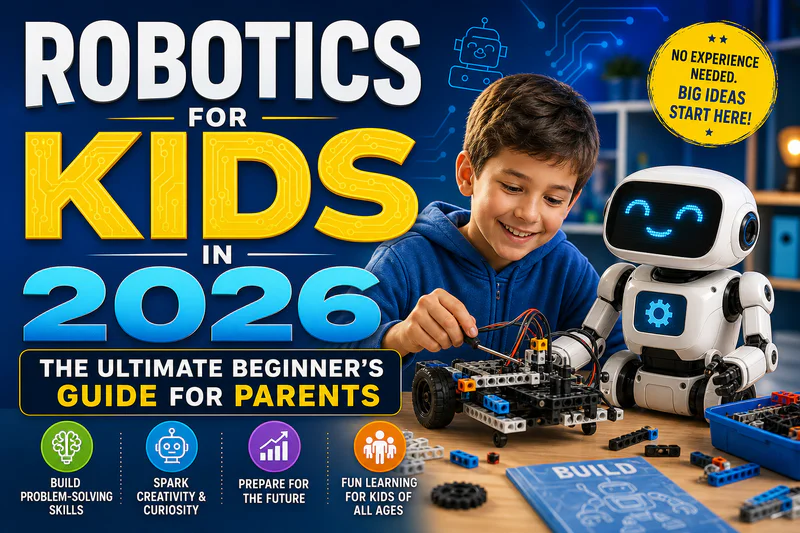
The global educational robot market is growing from $2.32 billion in 2025 to $2.75 billion in 2026, and that number tells only part of the story. Behind every dollar of that growth is a parent wondering how to give their child a real edge in a world increasingly shaped by automation and intelligent machines.
Robotics for kids is no longer a niche hobby. It is a structured, accessible, and genuinely exciting gateway into engineering, coding, math, and creative problem-solving. This guide gives you a clear, practical roadmap for starting that journey in 2026, whatever your child's age, budget, or experience level.
What Is Robotics for Kids, And Why Does It Matter in 2026?
Robotics for kids is the practice of building, programming, and controlling machines that interact with the physical world. It blends mechanics, electronics, and software into a single hands-on discipline that no textbook can fully replicate.
What makes robotics uniquely powerful for children is that it makes abstract concepts tangible. When a child writes code and watches a robot arm respond, logic stops being theoretical. It becomes real, immediate, and deeply motivating.
In 2026, the relevance is impossible to overstate. Automation is reshaping industries faster than educational systems can adapt. Children who engage with robotics for kids early develop the exact skills, systems thinking, debugging, iterative design, that will define tomorrow's most valuable professionals. According to a decade-long analysis published in Nature, educational robotics measurably enhances academic achievement, fosters creativity, and improves collaborative learning outcomes.
Robotics for kids is not about creating engineers at age eight. It is about building the cognitive resilience, curiosity, and technical fluency that every future career will demand.
The 5 Core Pillars of Robotics Every Child Learns

Every robotics project, from a simple LEGO build to a programmable drone, rests on five foundational pillars. Understanding these pillars helps parents frame what their child is actually learning when they sit down with a kit.
Mechanics is where robotics begins, designing and assembling the structural body of the machine. Children learn how parts connect, how weight is distributed, and how physical design affects function.
Electronics introduces sensors and circuits. Children discover how components like motors, LEDs, and wiring carry signals and power throughout a machine.
Programming is the robot's "brain." This is where coding languages, from Scratch programming for kids to Python for kids, come into play. The code determines how the robot thinks and responds.
Sensors allow a robot to perceive its environment, detecting light, sound, distance, or touch. Understanding sensors teaches children to think about inputs and how machines process information.
Actuators are the outputs, the motors, wheels, and arms that create physical movement and action. Children learn that every input eventually produces a measurable outcome, which is one of the most fundamental principles in engineering.
Robotics Concepts, Kits & Coding Languages: The Master Comparison Table
Not every kit is right for every child. The table below maps the most popular robotics platforms in 2026 to the coding languages and core skills they develop, giving parents a clean reference point before making any investment.
This table is your starting point. A seven-year-old excited about building will thrive with LEGO Mindstorms and Scratch programming for kids. A thirteen-year-old who wants to build a line-following robot should be moving into Python for kids via Arduino or Raspberry Pi.
The Coding Language Roadmap: From Scratch to Python to App Control
The learning journey in robotics for kids follows a natural progression. Forcing a child to skip steps typically leads to frustration; following the roadmap leads to confidence.
Step 1: Scratch Programming for Kids (Ages 5–10)
Scratch programming for kids uses a drag-and-drop, visual block-based interface that eliminates syntax entirely. Children focus on logic, sequencing commands, using loops, and building conditionals, without worrying about semicolons or indentation errors. Kits like LEGO Mindstorms and mBot integrate directly with Scratch-style environments, making Scratch programming for kids the ideal entry point into physical computing.
Step 2: Python for Kids (Ages 10+)
Once a child is comfortable with logic structures, transitioning to Python for kids opens the full world of text-based robotics. Python is the dominant language for Raspberry Pi projects, drone control, and AI-integrated robotics, and it is beginner-friendly enough that structured learning makes the leap manageable. Many families supplement their kit work with dedicated Python projects for kids to reinforce programming concepts with real-world applications.
Python for kids is also the gateway to machine learning basics, data handling, and advanced sensor integration, skills that have genuine value in 2026's job market.
Step 3: App Development Classes for Kids
The next frontier for young roboticists is building the controller, not just the robot. App development classes for kids teach children to design and code mobile interfaces that communicate with their robotic creations via Bluetooth or Wi-Fi. A child who can build a robot and design the app that controls it has moved from hobbyist to engineer in every meaningful sense.
App development classes for kids also reinforce UI/UX thinking, event-driven programming, and wireless communication concepts, all of which are directly applicable to real-world engineering roles.
Structured online coding classes for kids provide the scaffolded, progressive curriculum that ties these three stages together. Self-directed learning from YouTube tutorials is valuable, but a structured program ensures no foundational gaps are left behind.
Why Math Is the Secret Superpower Behind Robotics for Kids
Ask any robotics engineer what subject underpins their work, and the answer is almost always math. Robotics for kids requires spatial reasoning, geometric thinking, coordinate systems, and an intuitive feel for measurement and proportion.
When a child programs a robot to turn 90 degrees, they are applying geometry. When they calculate gear ratios for mechanical advantage, they are using algebra. When they analyze sensor data, they are thinking statistically. The coding and math for kids connection is not abstract, it is deeply embedded in every robotics challenge.
Online math programs for kids build the spatial and geometric foundation that makes these concepts accessible before a child even picks up a kit. When children already understand coordinate planes and basic trigonometry, programming robot movement becomes intuitive rather than overwhelming.
Math tutoring for kids becomes particularly valuable as robotics projects grow in complexity. Calculating torque requirements, understanding servo motor specifications, or designing sensor thresholds all involve engineering math that goes beyond a standard school curriculum. Targeted math tutoring for kids ensures those gaps don't become blockers.
One often-overlooked advantage is the mental agility developed through vedic math classes. Vedic math classes train children to perform rapid arithmetic mentally, a skill that directly parallels the fast, iterative problem-solving demanded in robotics debugging. Just as a vedic math practitioner quickly simplifies complex calculations without a calculator, an experienced young roboticist quickly identifies logical errors without re-running entire programs. Both disciplines build the same underlying cognitive speed and flexibility.
Online math programs for kids that integrate computational thinking alongside arithmetic give children the strongest possible mathematical foundation for robotics work.
Age-by-Age Guide: Starting Robotics at Every Stage

Early Years (Ages 5–7)
Simple snap-together kits with minimal electronic components are perfect here. The goal is exploration, not engineering. Scratch programming for kids, specifically visual environments that pair with LEGO Boost or similar kits, introduces sequencing and cause-and-effect in a completely low-stakes environment. Success at this stage looks like a child who excitedly says, "I made it move!"
Middle Years (Ages 8–12)
This is the sweet spot for robotics for kids. Children in this range have the cognitive maturity to work through multi-step problems and enough patience to debug. Kits like VEX IQ and mBot pair well with a blend of block-based and introductory text-based coding. Online coding classes for kids become especially valuable at this stage, providing structured progression from Scratch programming for kids toward early Python for kids concepts.
Math tutoring for kids also plays an important supporting role here, as school math may not keep pace with the concepts these children encounter in robotics projects.
Teens (Ages 13+)
At this stage, robotics for kids becomes genuinely sophisticated. Arduino and Raspberry Pi projects, drone programming with Python for kids, and custom app development classes for kids come together into complete, impressive builds. Teenagers can begin participating in competitions like FIRST Robotics, develop portfolio projects, and explore online coding classes for kids at an advanced level.
The Psychological Superpowers Robotics Builds in Children
Robotics for kids is one of the few educational activities where failure is built into the process, and celebrated. A robot that doesn't work is not a failure; it is data. Children learn to debug methodically, isolate variables, and try again without catastrophizing. This is resilience in its most practical, repeatable form.
The discipline also builds extraordinary depth in computational thinking for kids, the ability to decompose complex problems, identify patterns, and think algorithmically. These cognitive skills transfer directly into math, science, writing, and virtually every other academic domain.
There is also a powerful social dimension. Robotics for kids is frequently collaborative. Team-based builds require children to communicate technical concepts, resolve disagreements, and celebrate shared wins. These interpersonal skills are every bit as important as the technical ones.
Understanding the coding benefits for kids extends well beyond the screen, and nowhere is that more visible than in a robotics context, where code produces a physical, tangible result.
How to Get Started with Robotics for Kids at Home (Step-by-Step)
Getting started does not require a large investment or a background in engineering. Here is a clear, practical path forward.
Choose the right kit for your child's age and interest. Use the comparison table above as your guide. When in doubt, start simpler than you think necessary, frustration kills motivation faster than anything else.
Enroll in structured online coding classes for kids. A quality online coding classes for kids program provides the language fundamentals that transform kit instructions into genuine understanding. Without this, many children plateau quickly.
Build the math foundation in parallel. Enrolling in online math programs for kids alongside a robotics kit ensures children can handle the calculations their projects demand. Math tutoring for kids offers targeted support when specific concepts become blockers.
Introduce app development classes for kids as a next step. Once a child can build and program a robot, app development classes for kids give them a natural creative extension, designing the interface that controls their creation is motivating and technically rich.
Document and share progress. Encourage your child to photograph builds, record short videos, or keep a project journal. This builds the habit of reflective practice and creates a portfolio that will matter enormously when applying to STEM programs or competitions.
Robotics for Kids and the Future: STEM Careers in 2026 and Beyond
The World Economic Forum consistently identifies robotics, AI, and automation as the dominant forces reshaping the global workforce. Children who build a foundation in robotics for kids today are not just developing a hobby, they are preparing for careers that don't fully exist yet.
Robotics engineers, drone operators, mechatronics specialists, AI hardware developers, and autonomous systems designers are among the fastest-growing STEM careers for kids to be positioned for. Each of these roles demands the exact combination of skills that robotics for kids develops: coding fluency (particularly Python for kids), mathematical reasoning, systems thinking, and hands-on problem-solving.
Children who combine robotics experience with online coding classes for kids, structured math programs, and app development classes for kids enter their teens with a technical profile that rivals many university graduates. That is not hyperbole, it is the consistent finding from FIRST Robotics program research, which shows alumni dramatically outperforming peers in STEM-related academic outcomes and career readiness.
Conclusion
Robotics for kids in 2026 is the most complete STEM education a child can receive outside a university lab. It brings together building, coding, mathematics, and creative problem-solving into a single, endlessly engaging discipline that grows with your child from age five through their teens.
The path forward is clear: start with the right kit, build coding skills through structured online coding classes for kids, reinforce the mathematical foundation with dedicated math programs, and progressively advance from Scratch programming for kids to Python for kids to app development classes for kids. Every step compounds. Every project builds capability. And every debugging session builds a more resilient, capable thinker, one who is genuinely ready for whatever the future demands.
Frequently Asked Questions
What age should kids start robotics for kids?
Children as young as five can begin robotics for kids using simple snap-together kits paired with visual coding environments like Scratch programming for kids. Formal structured learning typically becomes most effective around ages seven to eight, when children have the focus and logical reasoning for multi-step projects.
What is the best beginner kit for robotics for kids?
For children aged five to nine, LEGO Boost or Mindstorms paired with Scratch programming for kids is the gold standard. For ages ten and up, mBot or VEX IQ offers a natural next step. Teenagers ready for text-based robotics should look at Arduino or Raspberry Pi, where Python for kids becomes the primary programming language.
Is robotics for kids too difficult or expensive?
Not at all. Entry-level kits start under $50, and many online coding classes for kids offer free or low-cost introductory modules. Scratch programming for kids is entirely free. Difficulty scales with the kit, starting age-appropriately ensures a positive, confidence-building first experience.
What coding languages are best for robotics for kids?
The ideal progression is Scratch programming for kids first (visual, block-based), then Python for kids for text-based control of platforms like Arduino and Raspberry Pi. As children advance, app development classes for kids add the ability to build custom mobile control interfaces.
How do online coding classes for kids support robotics learning?
Online coding classes for kids provide structured curricula that teach programming logic progressively, from Scratch programming for kids through Python for kids and beyond. This structured approach eliminates gaps in understanding that often arise from kit-only or tutorial-only learning, making the robotics for kids journey faster and more sustainable.
Can my child learn Python for kids and robotics remotely?
Absolutely. Python for kids is one of the most widely taught languages in online education. Quality online coding classes for kids programs deliver live, interactive instruction that covers both Python fundamentals and robotics applications. Children can complete Arduino and Raspberry Pi projects at home while receiving expert guidance remotely.
Why are online math programs for kids important for robotics?
Robotics for kids is fundamentally mathematical. Geometry, spatial reasoning, coordinate systems, and basic algebra are embedded in almost every project. Online math programs for kids build these foundations systematically, ensuring children can engage with robotics challenges confidently rather than being blocked by mathematical concepts their school curriculum hasn't yet covered.
How does Scratch programming for kids prepare beginners?
Scratch programming for kids removes syntax barriers entirely, allowing children to focus purely on logical thinking, sequencing, loops, conditionals, and events. These concepts map directly onto every robotics programming environment. Children who master Scratch programming for kids transition to Python for kids and other text-based languages significantly faster than those who start without this visual foundation.
What role do app development classes for kids play in robotics projects?
App development classes for kids teach children to design and build mobile interfaces that communicate with their robots via Bluetooth or Wi-Fi. This transforms a child from someone who follows robotics kit instructions into someone who designs complete systems, both the physical machine and its digital controller. It is the natural third stage of the Scratch programming for kids → Python for kids → app development progression.
How can math tutoring for kids and vedic math classes improve robotics skills?
Math tutoring for kids provides targeted support for the specific mathematical concepts that emerge in robotics projects, gear ratios, sensor calibration, coordinate geometry, and basic physics calculations. Vedic math classes complement this by developing rapid mental arithmetic and flexible number sense, directly mirroring the quick, iterative problem-solving mindset that robotics debugging demands. Together, math tutoring for kids and vedic math classes create a learner who is both mathematically accurate and mentally agile.