
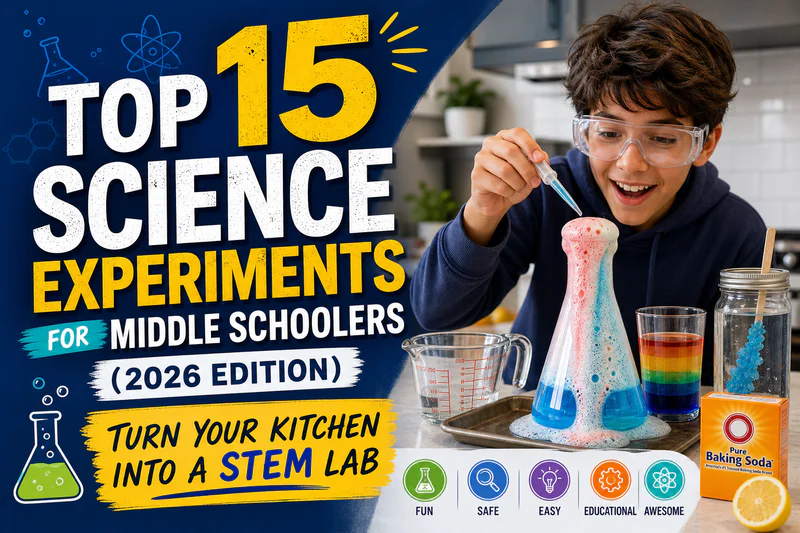
Most lists of science experiments for middle schoolers stop at the moment something fizzes. That is the easy part. The part that turns an afternoon activity into actual science is what happens next: changing one thing, running it again, and writing down what changed.
So each of the fifteen below comes with three things. What to do, what is physically happening and why, and the one variable worth changing to turn a demonstration into an experiment. Where there is a genuine safety consideration, it is stated rather than left out.
What actually makes these work
A child who has mixed cornstarch and water with their own hands has a physical memory of what a non-Newtonian fluid does. That memory survives in a way that a diagram in a textbook usually does not, and most teachers will tell you the same thing from the classroom.
The bigger gain is methodological. When an experiment goes wrong, and several of these reliably do on the first attempt, a child has to work out why, change something and try again. That loop is the whole of experimental science, and it is also, not coincidentally, the whole of debugging.
There is a measurable reason to care beyond the afternoon itself. The US Bureau of Labor Statistics projects employment in STEM occupations to grow 7.4% between 2025 and 2035, against 3.2% for non-STEM occupations. That gap is not a reason to push a child into science. It is a reason to make sure a child who likes it keeps liking it.
All fifteen at a glance

| Experiment | Materials | Concept | Adult needed |
|---|---|---|---|
| 1. Baking soda volcano | Baking soda, vinegar, dish soap, clay | Acid-base reaction, CO2 | No |
| 2. Water filter | Bottle, sand, gravel, charcoal, cotton | Filtration | No |
| 3. Egg drop | Egg, straws, tape, padding | Impulse and momentum | No |
| 4. Density rainbow | Honey, soap, water, oil, alcohol | Density | No |
| 5. Crystal growing | Alum, hot water, pipe cleaner, jar | Supersaturation | Yes, hot water |
| 6. Electromagnet | Iron nail, insulated copper wire, battery | Electromagnetism | Yes, heat risk |
| 7. Potato battery | Potatoes, galvanised nails, copper, LED | Electrochemistry | No |
| 8. Lung capacity | Balloon, ruler, notebook | Volume from diameter | No |
| 9. Chromatography | Coffee filters, markers, water | Separating mixtures | No |
| 10. Lava lamp | Oil, water, salt, food colouring | Density and polarity | No |
| 11. Bridge strength | Lolly sticks, glue, weights | Load distribution | No |
| 12. Milk plastic | Whole milk, vinegar, pan | Protein polymers | Yes, hob |
| 13. Solar oven | Box, foil, black paper, cling film | Radiant heat | Yes, food safety |
| 14. Red cabbage pH | Red cabbage, household liquids | Natural indicators | Yes, boiling |
| 15. Oobleck | Cornstarch, water | Non-Newtonian fluids | No |
The fifteen, in detail
1. Baking soda volcano
Build a clay cone around a small cup. Put in two tablespoons of baking soda, a teaspoon of dish soap and some food colouring, then pour in half a cup of white vinegar.
The science. Acetic acid reacts with sodium bicarbonate to produce carbon dioxide. The dish soap traps the gas as foam, which is why it climbs rather than simply fizzing.
Change one thing. Run it four times with 1, 2, 3 and 4 tablespoons of baking soda, keeping the vinegar constant, and measure eruption height against a ruler taped behind it. The height stops increasing at some point. Working out why is the actual lesson, because the vinegar runs out first.
2. Homemade water filter
Cut a plastic bottle in half, invert the top as a funnel, and layer cotton, then activated charcoal, then fine sand, then coarse gravel. Pour muddy water through slowly.
The science. Each layer catches particles at a different size. The charcoal adsorbs some dissolved compounds, which is why it changes smell as well as clarity.
Change one thing. Remove one layer at a time and compare. The water is not drinkable afterwards, however clear it looks, because filtration does not remove bacteria.
3. Egg drop challenge
Build a casing from straws, tape and padding. Drop from one metre, then higher.
The science. Newton's laws, specifically impulse. The force on the egg depends on how long the collision takes, so a design that slows the stop over a longer distance wins. Crumple zones in cars use the same idea.
Change one thing. Keep the design and vary the height. Find the height at which it fails, then redesign for that height rather than for one metre.
4. Density rainbow

Pour honey, then dish soap, then coloured water, then vegetable oil, then coloured rubbing alcohol, each slowly down the side of a tall glass.
The science. Density is mass per unit volume. Pour order matters because a dense liquid dropped from height will punch through the layers below it.
Change one thing. Drop in small objects, a grape, a bolt, a bead, and predict the resting layer before letting go. Predicting first is what separates this from decoration.
5. Crystal growing, with alum rather than borax
Dissolve as much alum as will go into hot water, suspend a pipe-cleaner shape from a pencil, and leave it overnight.
Safety note, and this is a change from the usual version of this list. Most crystal-growing instructions call for borax. We no longer recommend it for children. Borates carry a harmonised EU classification as toxic for reproduction, category 1B, and boric acid appears on the European Chemicals Agency Candidate List of substances of very high concern. Alum, sold in supermarkets as a pickling spice, is food grade and grows comparable crystals. An adult should handle the hot water either way.
The science. Hot water dissolves more solute than cold. As it cools, the solution becomes supersaturated and the excess comes out of solution, building onto any rough surface available.
Change one thing. Cool one jar on the worktop and one in the fridge. Slow cooling gives fewer, larger crystals. Fast cooling gives many small ones.
6. DIY electromagnet
Wrap insulated copper wire tightly around a large iron nail, fifty turns or more, and touch the bare ends to a 1.5V battery. Pick up paperclips.
Safety note. This is a near short circuit. The wire and the battery get hot within a minute or two, so connect in short bursts and disconnect between tests. Use a single AA or AAA cell, never a rechargeable lithium pack.
The science. Current through a coil produces a magnetic field, and the iron core concentrates it. The field strength rises with the number of turns.
Change one thing. Count paperclips lifted at 20, 40, 60 and 80 turns. Plot turns against paperclips. The relationship is close to linear, which is a satisfying thing for a child to discover rather than be told.
7. Potato battery
Push a galvanised nail and a piece of copper into each of two potatoes, wire them in series, and connect a low-current LED or a digital clock.
The science. The potato is not the power source. It is the electrolyte. The energy comes from the zinc coating oxidising, which is why the nail corrodes and the potato does not noticeably change.
Change one thing. Swap the potato for a lemon, an apple and a glass of salt water. Acidity and ion concentration both matter, and the ranking usually surprises people.
8. Lung capacity
Blow fully into a balloon in one breath, pinch it, and measure the diameter. Volume is V = 4/3 πr3.
The science. This measures vital capacity, the most air you can move in one breath. The cube in the formula is the interesting part: a 10% bigger diameter is a 33% bigger volume.
Change one thing. Measure three breaths each for several people and take the best. Then compare before and after two minutes of running. This is a good one for reading a graph properly, because the person-to-person spread is usually larger than the exercise effect, which is a genuinely useful thing to notice.
9. Paper chromatography
Draw a thick line of washable marker a centimetre from the bottom of a coffee-filter strip. Dip only the edge below the line into water.
The science. Pigments differ in how strongly they stick to the paper and how readily they dissolve in water. The ones that prefer the water travel furthest, so the colours separate out.
Change one thing. Compare black markers from different brands. They separate into entirely different sets of component colours, which is the moment the point lands.
10. DIY lava lamp
Three-quarters fill a jar with vegetable oil, top up with coloured water, then sprinkle salt on top.
The science. Oil is less dense than water and the two do not mix, because water is polar and oil is not. Salt sinks through the oil carrying a droplet of it down; as the salt dissolves in the water below, the oil floats back up.
Change one thing. Time the round trip with different amounts of salt. An effervescent vitamin tablet does the same job by a completely different mechanism, which is worth asking about.
11. Bridge strength test

Build a span of at least 30 cm from lolly sticks and glue, let it dry for a full day, then load it until it fails.
The science. Triangles do not deform without changing the length of a side, which is why trusses are made of them. Most first attempts fail at a joint rather than in the middle of a stick.
Change one thing. Record load at failure divided by the mass of the bridge. That ratio, not raw strength, is what engineers actually optimise, and it rewards the elegant design over the heavy one.
12. Milk plastic
Heat a cup of whole milk until it just steams, stir in four teaspoons of vinegar, strain the curds, knead and shape, then dry for 48 hours.
Safety note. Hob work, so an adult does the heating. Skimmed milk will not work.
The science. Acid makes casein proteins unfold and clump into long chains. The result, casein plastic, was manufactured commercially for buttons and jewellery well into the twentieth century.
Change one thing. Weigh the dried plastic and compare against the milk volume to get a yield. Repeat with semi-skimmed and see the yield fall with fat content.
13. Solar oven
Line a pizza box with black paper, foil the inner walls, seal the opening with cling film and angle the lid to reflect sunlight in.
Safety note on food. A cardboard solar oven typically reaches somewhere around 60 to 90°C on a good day, which melts chocolate perfectly well but is not reliably hot enough to cook anything containing raw egg, meat or dairy. Treat it as a heat experiment, not a cooking appliance.
The science. Black absorbs across the visible spectrum, foil reflects, and the cling film lets short-wave light in while trapping the longer-wave heat radiated back.
Change one thing. Put a thermometer inside and record the temperature every five minutes for an hour. The curve flattens out rather than rising forever, because losses grow as the inside gets hotter.
14. Red cabbage pH indicator
Boil chopped red cabbage until the water goes deep purple, strain, and add a little to cups of lemon juice, vinegar, milk, baking soda solution and soapy water.
Safety note. Boiling water, so an adult does that step. Do not mix household cleaning products together to test them.
The science. Anthocyanins change molecular shape with pH and absorb different wavelengths as a result. Acids push it pink and red, alkalis push it green and yellow.
Change one thing. Build a reference scale from substances of known pH, then use it to estimate an unknown. That is exactly how an indicator is used in a real laboratory.
15. Oobleck
Mix roughly one cup of cornstarch into half a cup of water. Press slowly and your finger sinks. Hit it and it resists.
The science. It is a shear-thickening suspension. Under sudden stress the starch particles jam against each other and the mixture behaves like a solid; released, they slide and it flows.
Change one thing. Vary the ratio in steps and find the narrow band where the effect is strongest. It is narrower than most people expect.
Not sure which level your child should start at? A free trial class with a Codeyoung teacher shows you exactly where they are and what they are ready for next, before you commit to anything.
Book a Free Trial →Turning an afternoon into a project
The difference between a demonstration and an experiment is a table of numbers. Any of the fifteen above becomes a science fair project the moment a child runs it several times with one thing deliberately changed and records the results.
Four of them are particularly suited to it because they produce a curve rather than a single outcome: the solar oven temperature over an hour, the electromagnet against coil count, bridge load against design, and crystal size against cooling rate. Those four give a child something to plot, and a graph with a visible trend is what a judge is looking for. Our guide to how much help a parent should give on a science fair project covers where the line sits.
Two habits raise the quality of any of them. Write the prediction down before running the test, because an unrecorded prediction is always remembered as correct. And repeat each condition three times, since three runs of an identical setup give three different numbers, and understanding why is the beginning of real data handling. Our post on fair tests and controlling variables goes into the method properly, and why some children pass science tests without understanding the science explains why hands-on work matters more than it looks.
Where to go next
A child who enjoys these tends to want the next thing, and the next thing is usually either more measurement or more building. Measurement leads naturally toward handling data, graphing it and eventually writing a few lines of code to plot it. Building leads toward design and engineering.
Neither needs to be bought. A notebook and a willingness to repeat a test is most of it. Where structured teaching helps is in the part these lists never cover: knowing what question to ask next when an experiment produces a result nobody predicted.
Codeyoung runs 1:1 live online classes for children aged 6 to 17, with a teacher who adapts the pace to your child rather than a fixed syllabus. The first class is free, so you can see how they respond before deciding.
Book a Free TrialCodeyoung's online science classes are built around investigation rather than recall.
Sources checked 9 October 2026: US Bureau of Labor Statistics, Employment in STEM occupations, for the 2025-35 projections; the European Chemicals Agency harmonised classification and Candidate List entries for boric acid and borates.